In today’s video I’ll be continuing from my last video and showing you how you can combine the CAGED system with some handy shapes for common chord substitutions to enhance your playing as you move up the fretboard, to add interesting rhythmic and harmonic elements over the top of LOUD folk session guitar players!
I’m finally back with another tutorial! This will be a two-parter, showing you how you can play over the top of LOUD guitarists in sessions while still being heard and adding something interesting to the overall sound. In this part we’ll be looking at how the CAGED system can be used to quickly find alternative chord voicings higher up the fretboard. I’ll also be showing you how you can take those and use them to quickly find the three main chords for popular major keys. In part two, I’ll be looking at some more advanced tips and tricks which will enable you to add substitutions and cover tunes in minor keys and the mixolydian mode.
My upcoming harp and guitar Zoom accompaniment workshop with Tiffany Schaefer is coming up very soon, on July 13th 2025! Click here to find out more and book your spot!
The PREVIOUS workshop can be watched back by clicking here.
Here’s another video from Folk Friend Celtic Guitar Tutorials, celebrating the release of my latest book (see below) with a guide to how to use inversion shapes for Irish and general Celtic guitar accompaniment in the key of A major / ionian! I’ll be using an Irish polka called Ger The Rigger which you can find in the Folk Friend tune playalongs pack with on-screen guitar chords and played on a loop at three different speeds- perfect for practicing your Irish guitar backing!
In this free lesson from Folk Friend I’ll be running complete beginners through the top 5 tips for complete Irish guitar beginners! I’ll be showing you how to hold your guitar and plectrum, some of the best things to learn to begin with, which chords fit with tunes in the most common keys and general tips for how you can improve your Irish guitar backing fast!
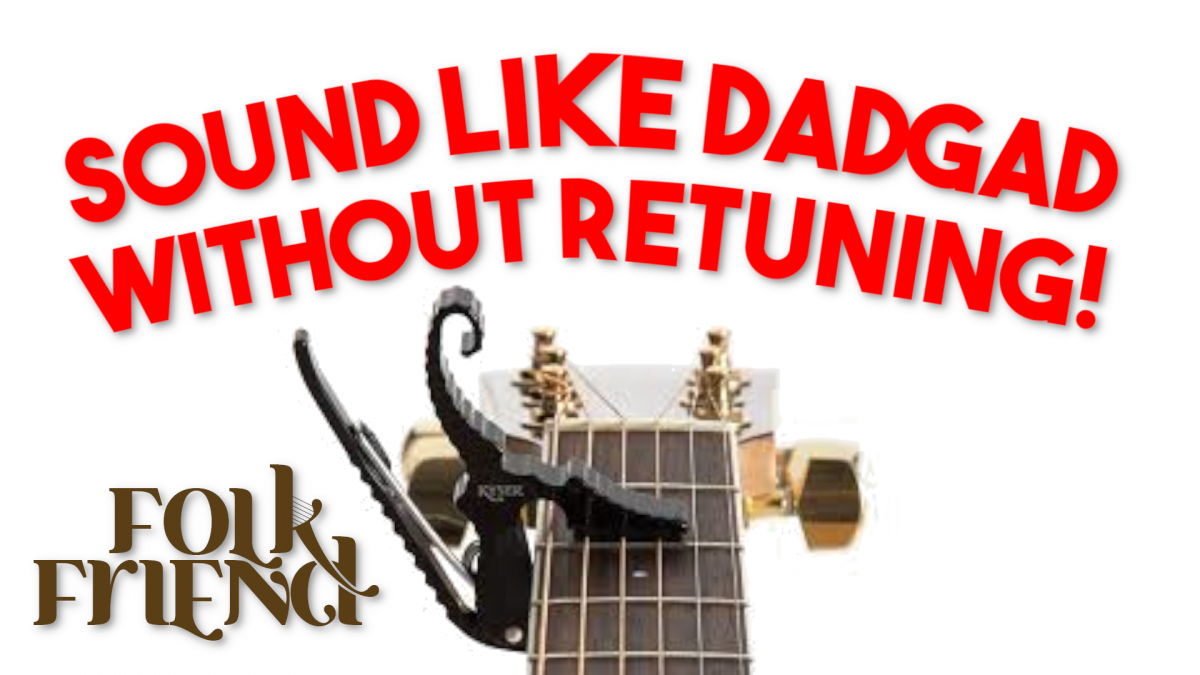
This free Irish guitar lesson from Folk Friend covers partial capo-ing, the easiest way to get the classic sound of DADGAD folk guitar without retuning or learning a single new chord shape!
I recommend the Kyser partial capo as it is quicker and easier to move around. You can now support Folk Friend by buying one directly from me (cheapest price in the UK guaranteed). Click here to shop now!
I recently finished writing a complete Beginner’s Guide To Celtic DADGAD Accompaniment! You can find it here.
In this free Celtic guitar lesson I’ll be showing you one really simple shape which you can move around to give you loads of great chord options for tunes in E minor type keys. This is useful for both E dorian and E aeolian. These shapes can also be used in lots of other keys with varying degrees of success so experiment!
In this video I respond to a message from Claire who wanted to know how capos work. I also show you an unusual way to use a capo to create more interesting textures to your chordal backing for Celtic music! I sell quick change capos which can be used for partial capoing and also moved around the neck really fast! They cost £10 with postage included and can be purchased here.
I also sell Kyser quick change partial capos, which can fret three strings while leaving the others open. This is very handy for getting the DADGAD sound without learning any new shapes and also has loads of other cool applications! Check them out here.
Shubb make a capo specifically for partial capoing. It is shorter than the standard capo so as to only barre a few strings at a time. You can get one here: https://amzn.to/2yzTB9R
My description of the Spider capo was a little misleading- they only capo one fret at a time, but can capo or not capo each string individually. Anyway here is where you can get one (there are cheaper versions, but these are the originals and probably better quality- I also feel that we should support the designers of clever things like this): https://amzn.to/2X3Lw7w
In this week’s free Irish / Scottish / Celtic guitar lesson, I’ll be finishing off my series of videos about how to pick chords by ear. In this one I’ll be covering the dorian, aeolian and mixolydian modes and showing you how to apply what you have already learnt in my previous videos to quickly and easily pick the right chords to back your favourites folk tunes every time!
In my previous free guitar lesson I showed you how to pick the right chords for Irish / Celtic music by ear. I realised after I’d made it that there was another chord available to you, so I’m following up with one more type of simple chord substitution you can use to make your Irish backing guitar more interesting! If you haven’t already seen it, watch part 1 here.
I’m sorry that I was cut off by a technical difficulty so didn’t have time to look at the other two modes I had planned to cover. Next time I’ll be finishing this topic off going through a few classic Irish and Scottish tunes in the mixolydian and aeolian modes and showing you, first how to pick out simple chords and second how to use substitutions to make them more interesting.
The fourth Folky Fridays livestream Irish guitar lesson covered how to pick chords by ear for Irish, Scottish or Celtic tuned in the dorian mode. I was working with the jig Slieve / Sliabh Russell, which is in the mode of A dorian. You can find it played slowly here:
And faster here:
As ever I’d love to hear any questions you have! Leave me a comment in the box and I’ll do my best to help however I can :).