In this week’s free Irish guitar tutorial from Folk Friend I will be running you through a very popular modern session jig called Donegal Lass, written by Brian Finnegan of Flook fame. I will be showing you how you can analyse a melody by ear and quickly pick out the best chords to accompany it! I will also run you through basic guitar chord substitutions that you can use to add variation to your Irish guitar backing. This is also applicable to Scottish and Welsh folk music (and that of most of north western Europe).
This week on Folk Friend’s weekly Celtic guitar tutorial video I’ll be running you how to pick chords for Irish, Scottish and general Celtic music in the most common type of minor key, the dorian mode.
This week’s free Irish guitar lesson from Folk Friend is for complete beginners who want to learn how to accompany Irish traditional music on the guitar by ear. I’ll be showing you which chords fit with a tune in a major key and how you can train your ears to recognise where those chords should fit. I’ll also be giving you some examples using my free playalong video with on screen guitar chords for a classic Irish reel called Maid Behind The Bar. You can find that video here:
This tune doesn’t have any strong chord IV sections in the A part, so in the simple version I have simply stuck to the “folk formula”- chord V on every seventh foot tap, resolving to chord I at the end of each section. The B part’s third and fourth bar very clearly outline a G major chord. The notes of the melody here are G A B D B A, G A B D B D. The notes of a G major chord are G, B and D. NB- when picking chords to accompany a tune, the most important notes to listen to for chord choices are the ones on the dominant beats which I have written in bold text. In the interests of simplicity for the beginner guitarist I have used E minor instead of G major- this is valid as E minor is G’s related minor, so the two chords can be used interchangeably. Aside from these two bars, the B part also follows the standard formula.
Substitutions
In the A part of the tune I have switched A minor to F major. This is actually a chord borrowed from the aeolian mode. In the key of A dorian, the F chord should be an F# diminished as in A dorian’s related ionian mode, G ionian. However if we were in A aeolian the 6th chord would be F major. A minor chord can always be substituted for either the chord which is two above it in the scale (its related major chord) or that which is two below it in the scale (another chord with which it shares two notes in common). In this instance I have used the chord two below as it would be in the aeolian mode instead of as it would be in the dorian mode. The reason that this nifty trick works is because there is only one note different between the dorian scale and the aeolian one. Compared to a major scale, the dorian mode has a flattened 3rd and flattened 7th while the aeolian has a flattened 3rd, flattened 6th and flattened 7th. It is this flattened 6th which gives the aeolian mode its darker character than the dorian. By borrowing the F chord from A aeolian, your accompaniment will give the tune a darker flavour than it would have had if you had used the F#dim (or a substitute thereof) which you would expect in the dorian mode. You can get away with this in the third bar of the Cliffs of Moher because there is no 6th note in the melody anywhere in this bar. This is a common feature of Irish melodies, that in minor (dorian or aeolian) tunes, the 6th note rarely appears, meaning that you can often use the chords of either the dorian or the aeolian mode, or a combination of both, for artistic effect. You can find out more about this technique in my free video on the subject here.
In the B part I have followed the G chord outlined in the second bar, and then replaced it with its related minor (Em) in the third. I have substituted an F (again, borrowed from the aeolian mode) for the A minor in bars 5 and 6. Bars 7 also outlines the notes of a G chord, so I’ve added one in.
Jazzy substitutions
In this version, I wanted to go for a “gypsy jazz” flavour, so I have begun with the “Django chord”, aka an A minor add 13 (I’ve notated it as Am13 on the video to save space- the difference between an actual Am13 chord and this Am add 13 chord is that Am13 should contain the flattened 7th note, G, as well as the root, ♭3rd, 5th and 13th, but this chord does not).
I have replaced the F majors throughout with F major 7. This F chord is borrowed from the mode of A aeolian. A aeolian is related to C ionian and therefore has the same chords as that mode. In C ionian, F would be chord IV and therefore if you wanted to play a tetrad (jazzy 7 chord) for it, it would have to be F major 7- hence that is the chord which I have used in this context.
Once you have descended into jazz land, any chord which resolves down a fifth can be replaced with a dominant or altered dominant chord. For this reason I have replaced my chord Vs in this version with an E7#5 chord. This is a really classy chord V and, due to its flattened seventh and altered chord tone, the #5th, very much sounds like it wants to resolve back to chord I immediately afterwards (resolving down a fifth, from V to I).
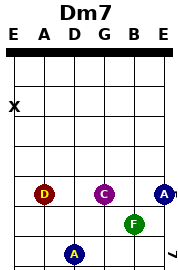
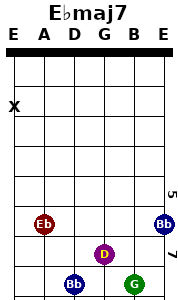
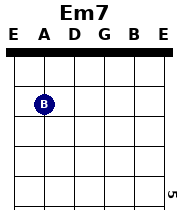
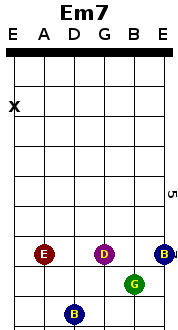
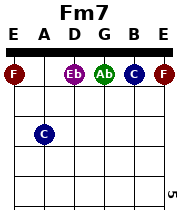
When the A part repeats, I have made a change to the chords for contrast. In the 5th bar of the A part repeat I have borrowed the D minor chord from A aeolian (acceptable as there is no 6th note of the A dorian scale in this bar of the melody) and played an ascending aeolian chord run from the Dm7 – Em7 – Fmaj7 before ending the section with my altered dominant V – I.
For the B part I have used a more traditionally dorian set of chords. Whenever you are playing in any mode other than ionian, chord VII becomes a dominant chord (9, 11 or 13). For this reason I have used G13 in the third and fourth bars. I also like G13 and Am add 13 together as they are particularly easy chord shapes to switch between at speed.
The D9 chord used in bars 7 and 8 gives the section a characteristically dorian feel. Recall that A dorian contains the same chords as G ionian, meaning that the IV chord in the dorian mode is equivalent to the V chord in the aeolian mode, and therefore has to be a dominant 7 type tetrad. For this reason my inclusion of a D9 here provides a very clear jazzy dorian vibe.
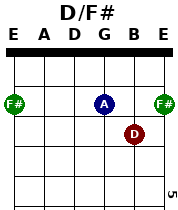
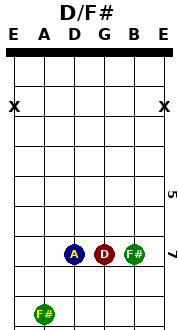
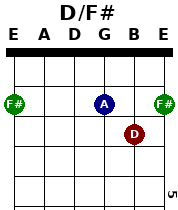
When the B part repeats, the tune contains a section in bars 5-6 of the repeat which is basically a descending scale from the 5th (E) down to the second (B), punctuated with E notes (E – E D E E, C E E B E E). I have sought to replicate this descending figure in my chords by descending from Fmaj7 to Em7. The next bar is an ascending scale and includes the 6th note of the A dorian scale, F#. For this reason I have played D/F# in my chords for this bar. As that sets up an ascending bassline from E – F#, it seemed right to use G13 instead of an Em or E7 type chord for the last chord V section. This continues the upward motion in the bass and then takes me back to my root note, E – F# – G – A.
This tune has been widely played in both Scotland and Ireland since at least the middle of the 19th century. It is named after Tom Payne’s 1791 book of the same title, which refuted Edmund Burke’s Reflections On The Revolution In France and supported the cause of the French revolutionaries in light of the government’s failure to protect their human rights.
Basic chords
The tune is in E aeolian. This means that the complete list of available chords is:
Em, F#m, G, Am, Bm, C, D,
I have broken this tune down primarily into chords I, IV and VII. This is effectively the same thing as breaking the tune down into I, IV and V. Chord VII (D) is the related major of chord V (Bm) which means that the two can be used interchangeably- I have mainly used chord VII as I like its brighter feel and find it easier to play at speed. The only time I have used chord V (Bm) is to make a clear marker for the ends of the sections.
Substitutions
In this version I have used chord VII (D) in the second bar. This is because this bar contains an F# note on its fourth beat, which is a chord V family indicator. This means that chord V or its related major chord VII can sound nice over this bar. As I went for chord VII I have used chord V at the end of the fourth bar for contrast.
The C major in the third bar is a substitute for E minor (chord III substituting for chord I) as you can always replace a minor chord with the major which is two above it in the scale (its related major) or the one which is two below it. The fourth bar has changed from D to Am-D. This is because if you have a long block of any chord you can always make it more interesting by working your way round the circle of fifths (using only chords from within the key) to FINISH UP on that chord. In this instance I have resolved from A to D instead of just playing D. As I am in the key of E aeolian, the A chord has to be A minor.
In the B part I have substituted a C for the E minor chords in the second half of the A part. It is common to replace a minor chord with the major chord two notes below it for contrast, as this chord contains two of the same notes. In this instance C is two notes behind E so C major is a good substitute for E minor.
Jazzy substitutions
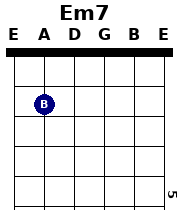
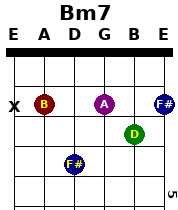
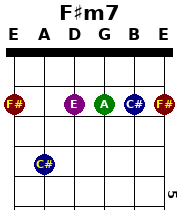
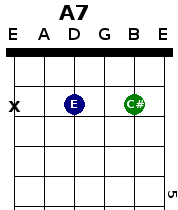
These are a fairly standard set of jazzy substitutions. As you can see I have more or less maintained the progression from the simpler substitutions, just adding the “right kind” of seventh note to each of my chords to give each one a jazzier flavour. As we are in E aeolian, our complete list of available tetrads (chords with sevenths) would be the same as in G major, aka G major 7, A minor 7, B minor 7, C major 7, D dominant 7 (often just called “D7”), E minor 7 and F# ½ diminished. If you wish to understand exactly why these are the available chords you can find a complete guide to the music theory involved in my book Backing Guitar Techniques For Traditional Celtic Music.
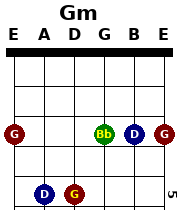
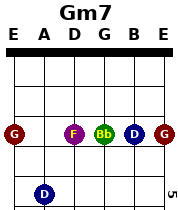
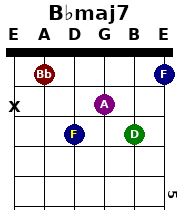
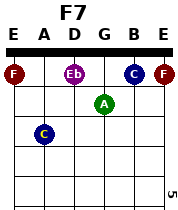
They can be played with the following “standard” jazzy barre chord shapes:
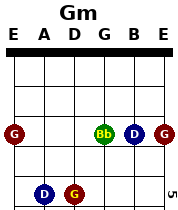
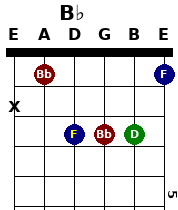
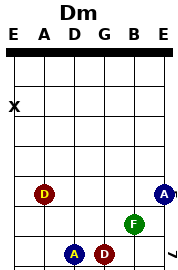
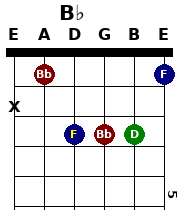
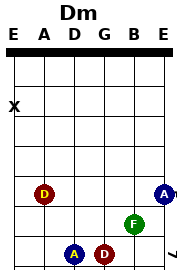
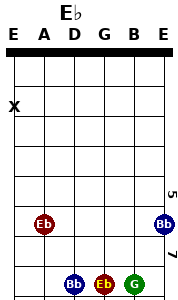
This tune is fairly simple in its chord options, but not simple in the fact that they are mostly barre chords! It’s written in the uncommon mode of G aeolian, whose key signature is the same as that of B♭ major. Therefore the available chords are G minor, A diminished, B♭ major, C minor, D minor, E♭ major and F major. The simple chords can be broken down into just I, IV and V aka Gm, Cm and Dm.
Basic chords
In the basic chords I have replaced the third and fourth bars, which are really just another chord I section, with B♭ major. This works because G minor’s related major is B♭ major (a minor chord’s related major chord is always two notes above it in the root scale) so the two can be used interchangeably to break up lengthy chord I sections.
This tune is somewhat unusual in that in the second half of the A part (second line) it doesn’t go to chord V on the seventh foot tap but on the fifth. This is clear from the melody notes in bars 13 – 16; “D – D C B♭ – A – G – – – G – – -”.
In the B part, the second line could really have been a huge chord I section with chord V marking the end of the section as usual. However, I have used an E♭ chord instead of the first chord I. You can always replace a minor chord with its related major (whose root note is two above it in the key scale; in this key B♭ major would replace G minor) or, for a more wistful sounding substitution, with the major whose root note is two below it in the root scale, as in this instance where G minor is replaced by E♭ major. I feel that this “wistful” sounding substitution fits particularly well with the long, high B♭ note played in this bar.
Bars 11 and 12 of the B part have been accompanied with chord V. This is not something I would commonly do, but I didn’t want to go from my E♭ straight back to chord I (if you add a substitution and then revert to the “standard” chord I it really feels like you’ve started a story and given up half way through) so as there was still plenty of chord I section available, it made more sense to resolve back to my chord I by going via chord V. If you have a long section of any chord you can always break it up by resolving to said chord from the chord whose root note is a fifth above it in the given key.
Substitutions
In this version of the chords, the A part is the same. The B part however has been changed to use a descending chord run going down the scale from Gm all the way to Dm (chord V). To keep the descending run going in bars 13 and 14, chord I has been replaced with chord IV (Cm). It is always acceptable to put chord IV or any of its substitute options in a chord I section.
The section ends in the usual way by resolving from chord V (Dm) back to chord I (Gm).
Jazzy substitutions
In this version of the A part I have replaced each of my chords with the jazzy tetrad shape applicable for the key of B aeolian. As this key has the same key signature and therefore chords as D ionian (major), my tetrad options are: B minor 7, C# ½ diminished, D major 7, E minor 7, F# minor 7, G major 7 and A (dominant) 7.
I have more or less done the same in the B part except that I have also reinstated the V chord for the 7th foot tap.
The Kesh is written in the key of G ionian, so the available chords are G major, A minor, B minor, C major, D major, E minor and F# diminished.
The second bar goes “A – – A B D”, so it could be seen as a chord V bar. In order to avoid having chord V right near the start of the tune I have played A minor (chord II) instead. This works pretty well as most of the bar is full of A notes!
The third bar could take either C or G. I’ve gone for G for contrast and because this makes a more satisfying chord progression.
As in almost all folk music, the fourth bar takes chord V. On the repeat it resolves back to chord I for the second half of the bar, in order to make the section sound finished.
The seventh bar of the B part is really a chord I section- its notes are “G – – A – -” (either a whole bar of G or half a bar of G and then half a bar of D). However, replacing chord I (G) with chord IV (C) in this section creates extra tension which is then diffused byt eh resolution from chord V (D) to chord I (G) at the end of the section.
Substitutions
In bar three I have replaced G major with its related minor, E minor. In the fourth bar I have played chord V in its first inversion. This means that of the three notes normally in a D major chord, D, F# and A, the middle of the three, F# has been played at the lowest pitch within the chord instead of the root note D which would normally be the lowest note in a D chord. The reason I have done this is that it sets up a nice walking bassline from the E at the bottom of the E minor chord, via the F# at the bottom of D/F# (aka D in the first inversion) to G at the root of the G chord.
In the B part I have replaced G with its related minor, E minor and C with its related minor, A minor.
Jazzy substitutions
In this version I have taken the progression from the previous section and converted each of the chords into “the right kind of seven chord”. These are the “tetrads”, or four note “jazz” chords, where as well as the 1st, 3rd and 5th which make up the notes of a regular triad (three note chord) you also add the 7th note from the root note’s scale. You can discover the theory behind these in my first book Backing Guitar Techniques for Traditional Celtic Music.
For any major key the list of tetrads available is:
Chord I – major 7 –
Chord II – minor 7
Chord III – minor 7
Chord IV – major 7
Chord V – dominant 7
Chord VI – Minor 7
Chord VII – ½ diminished (rarely used in folk music)
So for our tune in G major, the options are G major 7, A minor 7, B minor 7, C major 7, D (dominant) 7, E minor 7 and F# ½ diminished. These simply replace the equivalent triad from the old progression, so D becomes D7 (note that it must be D7 NOT D major 7 because it is chord V), G becomes G major 7 and so on.
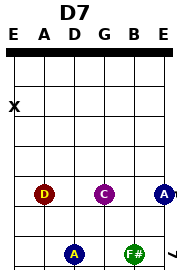
You can also add any chord extensions (extra notes) to a jazz chord, so long as the notes you add are from the key you are currently playing in. For example instead of playing D7 for my chord V I have used D9. This works fine because the 9th note in the D chord is an E, and E appears in the scale of G major so adding it sounds fine.
In bar four of the B part I have broken up a chord I bar by playing half a bar of G then half a bar of its first inversion, a G chord with B at the lowest pitch in the chord. This creates a nice little bassline to lead up into the C chord in the next bar. The same principle applies to the momentary shift from C back to G/B in the next bar- it creates movement in the bassline.
In bar 7 of the B part, I have used a nifty trick to create a chromatic link from a C chord to a D. Instead of just playing C major 7 followed by D7, I insert a C#½ diminished chord as a passing chord. You can use this to create a chromatic link between ANY two chords whose roots are separated by a semitone. For example, within the key of G, you could link G – Am (G – G#dim – Am), Am – Bm (Am – A#dim – Bm), D – Em (D – D#dim. – Em) etc etc. It also works in any mode, for any two chords whose roots are a tone apart.
This tune is in the key of D ionian. Therefore the available chords are D major, E minor, F# minor, G major, A major, B minor and C# diminished.
If you listen to the tune my choices should be relatively self-explanatory. Notice that each section ends with a resolution from A D, aka chord V to chord I.
Basic substitutions
I have substituted the G in the second line for its related minor, Em. I have also substituted the D in the second half of the third line for its related minor, Bm and the G in the final line for Em.
In the second line of the B part I have replaced one D chord with a D in the first inversion (D/F#). This chord still contains the notes of a D major triad, D, F# and A, but has them piled up with the F# at the lowest pitch within the chord. This means that functionally it is exactly the same as a normal D major chord, but it’s altered bass note creates a nice bassline which adds a sense of movement to the progression, jumping from D to F# before dropping back down for the E at the bottom of the E minor chord which follows it. In the third line I have used a similar trick to link a G chord to it’s related minor E minor, passing through D/F# in order to make a nice descending bassline, G, F#, E.
Jazzy substitutions
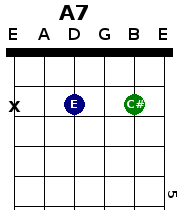
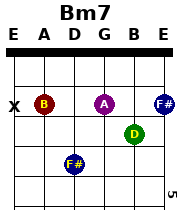
Because of the excessive speed at which polkas roll along, I have kept my chord choices relatively simple for this one! If you’re feeling jazzy, you can replace any chord with the “right kind” of seven chord, by which I mean that in the ionian mode chords I and IV can become major 7 chords, chords II, III and VI become minor 7 chords and chord V becomes a dominant 7 chord (usually just referred to as a 7 chord). This is why my Em7, A7 (this is chord V so it has to be “A7” NOT “A major 7”) and Bm7 all work well.
In the B part I have added a C natural (♮) chord- this is decidedly cheeky. What I have actually done there is to borrow a chord from the mixolydian mode, which is only separated from the ionian mode by one note. If this tune were written in D mixolydian, its scale would contain a C♮ instead of C#, and therefore its VII chord would be C major instead of C# diminished. As the 7th note of the scale, C#, is not in the melody in this bar I can borrow the cheeky flattened VII chord from D mixolydian. So long as there is no C# in the tune it won’t clash but will just lend the tune a blues-y character for a moment instead!
Changing the third line from “D D G G” to “Bm7 A7 G D/F#” works because Bm is related to D (and therefore so is Bm7), A7 is a passing chord which creates a nice step-wise descent to G and then D/F# is chord I (D) but with a bass note which continues the little descending bass run, which then culminates in E minor in the final line.
This tune is in the key of E aeolian. This means that the chords available are E minor, F# diminished, G major, A minor, B minor, C major and D major. Because aeolian is the sixth mode, these are the same chords which would be available in G ionian (major). The main chords will be I, IV and V relative to E minor, aka E minor, A minor and B minor.
As the tune is in 9/8, each bear contains three blocks of three notes. You can pick one chord for each of the three blocks if you wish. When finding the chord I, chord IV and chord IV sections, bear in mind that a section may only last a third of a bar. The tune also has three parts rather than the more usual two. Some people would call this a “48 bar slip jig” (16 in the A part, 16 in the B part and 16 in the C part).
In the A part of the tune, the last block of three quavers in bar one contains one long F# note. For that reason this section could be seen as a chord V section, because of chord I, IV and V, only chord V contains an F#. For ease of playability I have used chord V’s related major. Every minor chord has a related major chord, which is two above it in the key scale, and these two can always be used interchangeably.In this case B is the fifth note in the scale of E aeolian, and two notes above it is D, so D major can always replace B minor.
The last three quaver block of bar two contains the notes “F# E D”. The notes of a D major chord are D, F# and A so this section is firmly a chord VII/ chord V (recall that these two are interchangeable) section.
In bar 4 I could have continued to play E minor, but I have replaced chord I with chord IV, A minor. This works because you can play chord IV in place of any chord I section.
In the B part there are no sections which sound particularly like they need a chord IV or V. In slip jigs, because each bar contains three block of three quavers, and hence three foot taps, the usual rule about playing chord V on every seventh foot tap (whch applies in all other time signatures) becomes “Play chord V at least on every sixth foot tap, potentially for the whole fourth bar”. It’s not as snappy a rule, but it does the job! In this case, bar two contains the notes “A B B B A B D B A”. Only the third of these three blocks sounds like a chord V section to me, so I have played chord VII, chord V’d related major (Bm, chord V, would also have been fine, but it’s harder to play at speed).
In bar four however we find the notes “B – D G – E D B A”. This is much more clearly a chord V section as chord V, Bm, contains the notes B, D and F# and most of the notes in this section are either B or D.
In the C part we find a different melody but with a similar harmonic structure to part A.
Basic substitutions
In this version’s A part I have used D and Bm interchangeably. You can always swap chord V to its related major in any mode other than ionian.
In bar four I have replaced an E minor (chord I) with C (chord VI). This works because as well as its related major, whose root is two above its own in the root scale, a minor chord can also be replaced with the major chord whose root is two BELOW it in the root scale. This works because a C chord contains C, E and G and an E minor chord contains E, G and B- the two common notes make these two chords a valid substitution pair.
In a slightly more unconventional move I have begun the B part on C instead of E minor. I usually say you should start sections on their key chord (unless the melody clearly dictates otherwise) so that the listener has a firm idea of what key they are in. However, when playing in minor keys it is often nice to build tension by beginning a part on the chord whose root note is two below chord I’s in the key scale. In this case I deliberately avoid playing chord I anywhere in the section, always substituting it to C. This creates tension which then adds energy when chord I kicks back in in part C.
In the C part I have again replaced Em with G. I have also ended the section on chord IV. This can be a nice way to end an Irish tune- finish on chord IV instead of chord I! If you are in any mode other than ionian this will add a kind of lift to the end (try it in dorian and mixolydian too). If you are in ionian on the other hand it will leave the listener with a kind of wistful “grass might be greener on the other side” flavour.
Jazzy substitutions
In this version I have replaced each of the available chords in the key with the “right kind of tetrad”. In the simpler versions I used the more common three note chords called triads. These contain just a root, 3rd and 5th. A tetrad is a four note “jazz” chord which contains a 7th as well.
E aeolian is related to G ionian. Therefore the tetrads available are the same in both modes, aka:
G major 7
A minor 7
B minor 7
C major 7
D7
E minor 7
F# ½ diminished (rarely used in folk music- we’ll replace it with chord V in the first inversion, aka D/F#)
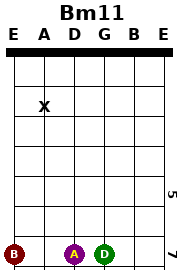
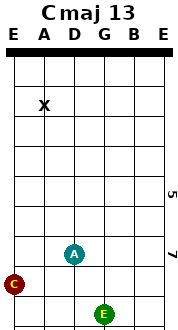
So for our tune in E aeolian, the options are E minor 7, D/F#, G major 7, A minor 7, B minor 7, C major 7 and D (dominant) 7. These simply replace the equivalent triad from the old progression, so D becomes D7, G becomes G major 7 and so on. Bm11 is a B minor 7 chord with the 11th (4th) note from a B natural minor (aeolian) scale added to it. This works fine in the key of A aeolian because Bm’s 11th is E, which of course is a note from the E aeolian scale. Adding any note from the key scale to a chord will just give you a jazzier sounding version of the same chord, and Bm11 is much easier to play than Bm7! The same goes for C major 13.
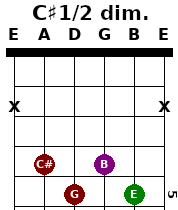
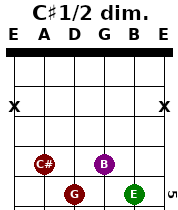
In bar four of the B part I have used a chromatic link from C maj 13 up to D7. Any time you have two chords in a progression whose roots are separated by a tone, you can create an ascending chromatic link between them by using a diminished or ½ diminished chord whose root note is on the semitone between the two original chords. In this case my progression goes Cmaj13 – C#1/2dim. – D7.
In the C part I have used a slightly unusual technique to create a “shimmery” sounding version on the part’s repeat. I replace chord I (Em7 in tetrad land) with chord IV from E dorian instead of E aeolian, aka A7. In this case I have left the top two open strings in the chord, to give me A9. This works well because the top two strings are B and E, the 5th and root of my key scale and adding any notes from the key scale to a jazzy chord will just give you an even jazzier version of the same chord. If you are playing a tune in the aeolian mode, you can often borrow chords from the dorian mode in order to give a moment of optimism to the tune. This works because Irish tunes in minor keys very rarely contain the sixth note of the scale, and it is this note which differentiates the dorian mode from the aeolian. In this case E aeolian should contain A minor 7 as its fourth chord, but I have used chord IV from E dorian, A7, instead! In dorian or aeolian you can always experiment with replacing chord I with chord IV from the other minor mode in order to create tension. If you are in the aeolian mode then dorian’s chord IV will sound bright and shimmery. If you are in the dorian mode then the aeolian chord IV will sound dark and regretful.
This tune is in the key of D ionian. That means that the available chords are D major, E minor, F# minor, G major, A major, B minor and C# diminished.
The third bar of the A part contains the notes “F# B B A B C# D B”. This sounds like a chord IV section to me, as G major contains G, B and D and two of the dominant beats in this bar are on B notes, which do not appear in chord I (D, F# A).
In the B part I have used an E minor (chord II) in the third bar. This is because the bar is basically running up the D major scale beginning from E, which is the same thing as saying “running up the scale of E dorian”. Of course an E minor chord fits nicely with an E minor scale!
Basic substitutions
In this version I have used D/F#, aka the first inversion of D major, to provide a nice linking bassline from D up to G. You can play this chord by looping your thumb round the back of the neck so that it frets the second fret of the bottom E string.
In bar three, instead of going directly to chord V, A major, I have resolved to it from the chord which is a fifth above it within the key scale. You can always do this- if you have a whole bar or more of a given chord you can play the chord whose root is a fifth above it before the original chord. I have also replaced half of bar seven, which previously just contained G major, with its related minor E minor. A major chord’s related minor is always the one whose root note is two below its own in the key scale (in this case G – F# – E minor).
In the B part I have replaced G with its related minor, Em and D with its related minor, Bm. It is always acceptable to switch chords I and IV in any key to their related minors for variation. I have also used the first inversion of chord I, D/F#, in several places. This chord sounds like it wants to move up to G, so it can be a good way to add a sense of movement to your chord progressions.
Jazzy substitutions
In this version’s A part, I have used D in the first inversion, or D/F#, as a linking chord to create a sense of movement between chords I and IV (D and G). The G major in the second bar works because you can always replace a chord I section with chord IV if you wish to.
In bar three I have replaced G major with its related minor, E minor. The related minor of any major chord can be found by going two steps down in the key scale from any major chord- in this case G – F# – E (minor). I proceed up the chord scale from Em – D/F# (a substitute for the F# diminished chord) – G – A, in order to arrive at chord V for the second half of the chord V section in the fourth bar. Remember that bars 4, 8, 12, 16 etc (multiples of four) all take chord V!
In bar 5 I have used both of the minor substitutions available for a D major chord- B minor and F# minor. B minor is the related minor of D major, and F# minor is the chord whose root note is two above D in the key scale. You can always substitute a chord for either the chord whose root note is two below it in the key scale, or the chord whose root note is two above it in the key scale. Both of these chords will have two notes in common with the original chord and so both will make good substitutes.
In bars seven and eight I have missed out the D/F# from my ascending chord run. This is because I have to get back to A in time to go from V – I at the end of the section. If I played the full ascending progression from the end of the first line, I would end the B part on chord V (A) instead of going from V back to I (D) to make it sound finished.
In place of A major I have used A7 as my chord V. You can always replace chord V in a major key with a dominant 7 chord, or any other dominant chord like a 9 or 13.
In the B part, just to show that it CAN be done, I thought I’d stick an actual chord VII in. I have used the tetrad (four note chord) form, C# ½ diminished in bar two. This chord contains the notes C#, E and G. An E minor chord would work well in this section, and this chord contains two of the same notes so it’s theoretically an acceptable option. You will probably find in practice that it doesn’t sound that great though- you could replace it with G, Em, D, Bm or loads of others!
In bar six I have slid my F#m chord down one fret for the second half of the bar. This creates a nice chromatic link down to the E minor chord in the following bar. Any time you have two chords whose roots are separated by a tone, you can slide between them in this way using barre chords.