Categories
Chord scales for modes DADGAD

How capos work and partial capoing for Irish and Celtic folk guitar

In this video I respond to a message from Claire who wanted to know how capos work. I also show you an unusual way to use a capo to create more interesting textures to your chordal backing for Celtic music! I sell quick change capos which can be used for partial capoing and also moved around the neck really fast! They cost £10 with postage included and can be purchased here.

I also sell Kyser quick change partial capos, which can fret three strings while leaving the others open. This is very handy for getting the DADGAD sound without learning any new shapes and also has loads of other cool applications! Check them out here.

Shubb make a capo specifically for partial capoing. It is shorter than the standard capo so as to only barre a few strings at a time. You can get one here: https://amzn.to/2yzTB9R


My description of the Spider capo was a little misleading- they only capo one fret at a time, but can capo or not capo each string individually. Anyway here is where you can get one (there are cheaper versions, but these are the originals and probably better quality- I also feel that we should support the designers of clever things like this): https://amzn.to/2X3Lw7w
Categories
Celtic music theory Chord scales for modes

How to pick chords for Irish / Scottish music in the dorian, mixolydian or aeolian modes- Folk Friend

In this week’s free Irish / Scottish / Celtic guitar lesson, I’ll be finishing off my series of videos about how to pick chords by ear. In this one I’ll be covering the dorian, aeolian and mixolydian modes and showing you how to apply what you have already learnt in my previous videos to quickly and easily pick the right chords to back your favourites folk tunes every time!

Here is the rest of the series:

Complete Guide to Celtic Music Theory part 1

Complete Guide to Celtic Music Theory part 2

Easiest Way to Pick Chords By Ear part 1

Easiest Way to Pick Chords By Ear part 2

Categories
Celtic music theory Chord scales for modes Ear training

Easiest way to pick chords for Celtic guitar accompaniment PART 2

In my previous free guitar lesson I showed you how to pick the right chords for Irish / Celtic music by ear. I realised after I’d made it that there was another chord available to you, so I’m following up with one more type of simple chord substitution you can use to make your Irish backing guitar more interesting! If you haven’t already seen it, watch part 1 here.

Categories
Celtic music theory Ear training

Easiest way to pick chords for Celtic guitar accompaniment by ear – Folk Friend

In this week’s free Irish guitar lesson I will be showing you the easiest way to pick chords for a tune in a major (ionian) key.

I’ll be working with my “Out on the Ocean Tune Loop” video, which you can watch here:

The music theory guides for Celtic music which I mentioned are available here:

Part 1

Part 2

Simple chords:

G / G / G / C /

G / G / C / D G X2


C / C / G / D /

G / C / G / D G X2


Example with related minors:

G / Em / Am / D /

G / Em / Am / D G X2


C / Am / Em / D /

G / C / Em / D G x2

Categories
Celtic music theory

Ultimate guide to Celtic/Irish music theory part 2 – how to find chords for any mode

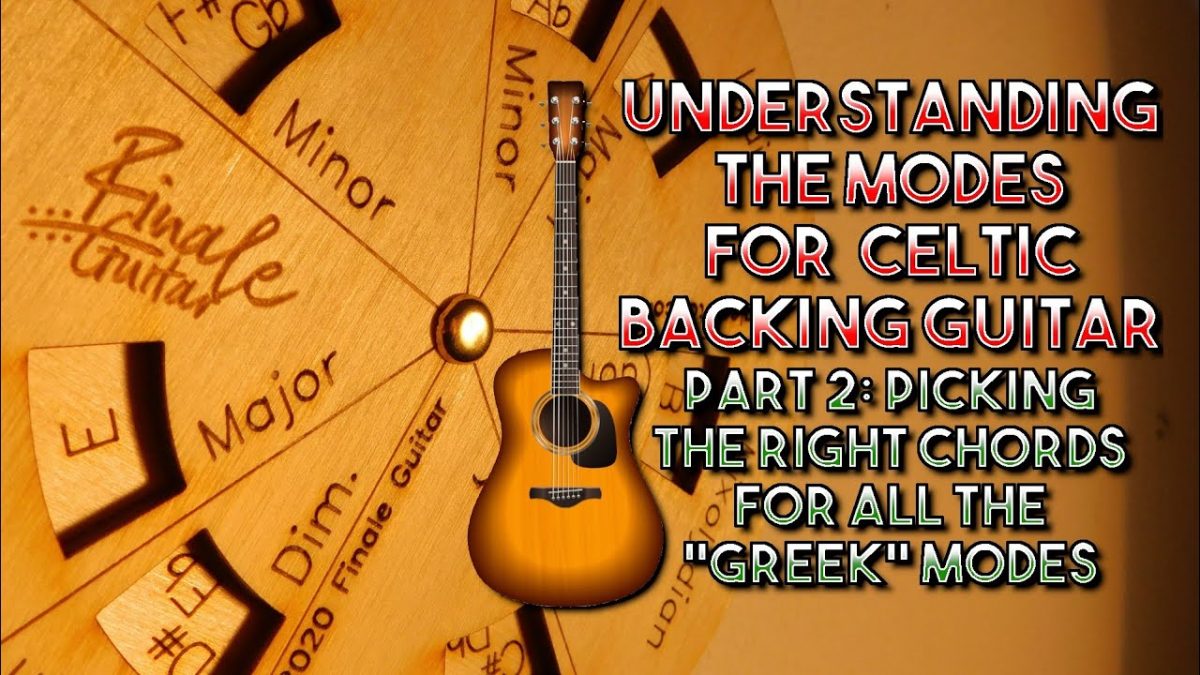
Hello again, and welcome to part 2 of my guide to scales, modes, and chords for Celtic backing guitarists! In this video I’ll be looking at the seven “Greek” modes formed from a major scale, particularly the four used in Celtic music; ionian, dorian, mixolydian and aeolian. You’ll learn how these modes are formed, which chords fit with each of them and how you can quickly and readily memorise their relationships in order to never be stuck for the right chords in a folk session ever again!

I’ll also be demonstrating my brand new invention, The Amazing Mode Wheel by Finale Guitar, which makes the whole topic much easier to understand, visualise and memorise.

You can read my blog dealing with the major scale and the chords which go with it here.

…And my complete guide to using the “Greek” modes for Celtic music here.

Watch part 1 here.

Categories
Celtic music theory

Ultimate guide to Celtic music theory for beginners 1 – scales and chords for major keys Folk Friend

Hello again, and welcome to part 1 of my guide to scales, modes, and chords for Celtic backing guitarists! In this video I’ll be looking at how a major scale (ionian mode) is formed, and how we can use this knowledge to find all the chords which will fit with a tune in a major key.

I’ll also be demonstrating my brand new invention, The Amazing Mode Wheel by Finale Guitar, which makes the whole topic much easier to understand, visualise and memorise.

You can read my blog dealing with the major scale and the chords which go with it here.

…And my complete guide to using the “Greek” modes for Celtic music here.

Here’s a link for the circle of fifths I use in the clip (thanks to Soundfly.com , a great site with lots of well-written tutorials).

If you want to get a better understanding of why the major scale is made up the intervals it is, and you’d like that information clearly presented using beautiful visualisations in a book which costs less then £5, then check out Harmonograph, one of my absolute favourites.

Watch part 2 of this video here.

Categories
Jazz chord theory

V-Is: most important chord progression in Celtic guitar!

Hello viewers! I had a comment from Ed Wright last week asking about chords for V-I progressions, so in this week’s Celtic guitar tutorial, I’ll be showing you a few of my favourite chord shapes along with some more unusual jazzy things you can do to make your V-Is more interesting!

You can find diagrams for all the guitar chords I use in this video on my blog, linked here.

Check out my blog on chord construction if you want to a simple music theory guide to help you learn more about how jazz chords are formed.

Categories
Chord scales for modes Folky Fridays Jazz chord theory

Folky Fridays #4 – Interesting chord progressions and music theory – Irish jig in the dorian mode

I’m sorry that I was cut off by a technical difficulty so didn’t have time to look at the other two modes I had planned to cover. Next time I’ll be finishing this topic off going through a few classic Irish and Scottish tunes in the mixolydian and aeolian modes and showing you, first how to pick out simple chords and second how to use substitutions to make them more interesting.

The fourth Folky Fridays livestream Irish guitar lesson covered how to pick chords by ear for Irish, Scottish or Celtic tuned in the dorian mode. I was working with the jig Slieve / Sliabh Russell, which is in the mode of A dorian. You can find it played slowly here:

And faster here:

As ever I’d love to hear any questions you have! Leave me a comment in the box and I’ll do my best to help however I can :).

Categories
Jazz chord theory Styles of great guitarists

How to play Irish guitar like zen master Dennis Cahill – part 1

In this video I’ll be running you through an Irish folk guitar chord progression and unusual strumming technique used by Dennis Cahill. The clip I show is from a live performance with Martin Hayes Live at the Irish Arts Centre, NYC, which you can watch in full below.

I should point out that in the B part of the clip, the second and third time through Dennis Cahill actually plays a slight variation on the chords I show. You can find diagrams for the variation on the accompanying blog for this video which is available here.

If you’d like to buy a whole album of Martin Hayes and Dennis Cahill, I particularly like Live in Seattle, which you can buy here. Please support Folk Friend by buying through these affiliate links, which gives me a small commission and enables me to continue to make more free videos!

Of course all their albums are brilliant and if you like more orchestral, arranged sounding folk music then check out The Gloaming too.

Categories
Chord scales for modes Jazz chord theory Styles of great guitarists

Using Django Reinhardt’s Gypsy Jazz guitar chords for Irish tunes in the dorian mode

This week’s free Irish guitar lesson from Folk Friend will be delving into some of the shapes popularised by Django Reinhardt which went on to define the sound of gypsy jazz… and how you can recycle them to make your Celtic backing guitar sound cool!

For examples of the amazing “Hot Club” sound of Django Reinhardt and Stephane Grappeli, check out the brilliant Platinum Collection album available here. Support Folk Friend by buying through this link- I will get a small commission if you do, which enables me to make more free videos!

For this Irish guitar lesson, we’ll be working with a reel in the dorian mode called The Star of Munster. The recording I play along with in this clip is by Matt Coleman:

There is also a slower version here: https://www.youtube.com/watch?v=2QprRbpc21k

And an even slower version here: https://www.youtube.com/watch?v=37OBWkXIlC4

Call Now Button